Have you noticed how British road safety campaigns have changed in recent years? How the UK they depict is bright and colourful, with people who look energetic and cheerful, compared with the older ones that showed people with more natural expressions, in a greyer, drearier Britain? Maybe, like me, you find the new road safety campaigns dishonest, that they don’t reflect the way most people interact in real life, and you want a return to more sobering depictions of road safety. Maybe you prefer the newer campaigns, with their friendliness and whimsy.
I’m going to talk briefly about four UK government road safety campaigns for television, two from around the millennium, and two from the early 2020s, to demonstrate how much has changed. All are roughly 30-40 seconds long and were run by the UK government, either by the Central Office of Information (pre-2000) or by THINK! (2000 – present).
The worlds we live in… (‘Julie,’ 1998, and ‘Backwards,’ 2003)
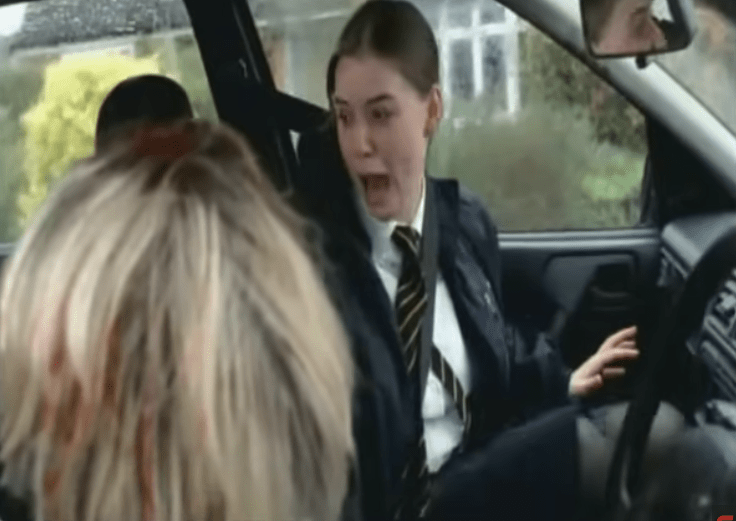
- ‘Julie’ has basic narration but no dialogue. We’re in suburban Britain. There’s a car parked, a family run-around. Mum is in the driver’s seat, Daughter next to her in school uniform. Son (also in uniform) jogs round the back and gets in behind Mum. He doesn’t put on a seatbelt. Mum starts driving and gets tailgated by a white van. She glances in the rear-view mirror nervously. She’s relieved when the van turns into another road behind her. Still distracted, she crashes head-on into another car. Son is thrown forward into the back of Mum’s headrest and the impact kills her. Daughter screams in horror. Son has killed Mum because he didn’t wear a seatbelt.
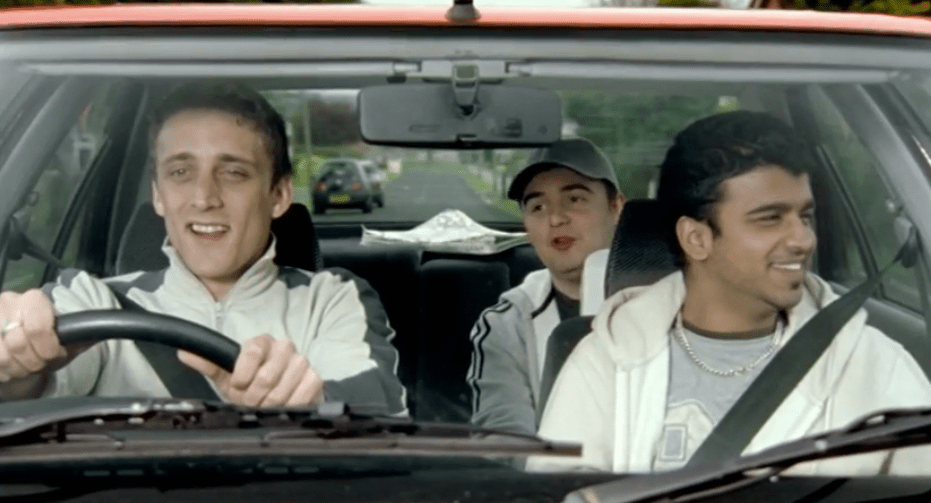
- ‘Backwards’ starts with the aftermath of a crash; we see the bloodied bodies of three men. The footage rewinds and plays again, except this time they put on seatbelts. We’re in UK suburbs once more; the men’s accents suggest Wales. The sky is grey. There is general chatter; the body-language and banter tell us the men are friends. They’re all in similar grey and black sportswear. One of them complains about the pizza he’s holding not matching what he ordered, and they all laugh. The car crashes again but they survive because they’re belted up. It ends with an image of smeared pizza on the windscreen.
…and the worlds we imagine (‘Mates for Life,’ 2021 and ‘Travel Like You Know Them,’ 2022)
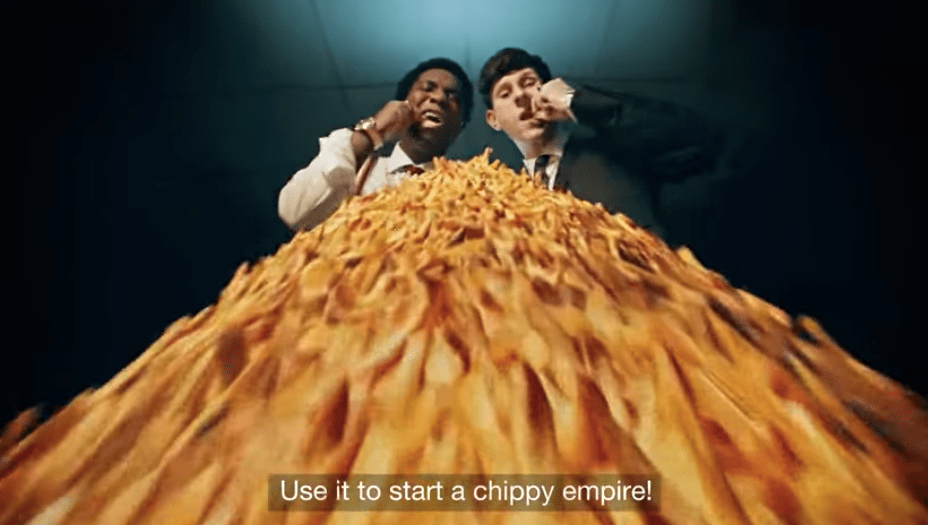

- ‘Mates for Life’ (2021) depicts two men in a pub. I’ll call them Educator and Educated because those are their roles. Educator tells Educated not to have another drink because they need to get fish and chips (presumably by car), and that this could be the start of an adventure. In Educator’s imagined adventure, the friends start a ‘chippy empire’ but the ‘fish and chip mafia’ don’t like it and kidnap Educated, who manages to escape into the woods to be ‘raised by wolves’ until he’s reunited with Educator and they get ‘Mates for Life’ tattoos. This adventure will only be possible if Educated doesn’t drink-drive. Educator explicitly calls Educated his ‘mate.’ The camera zooms in and out throughout the video and there’s a lot of costuming.
- ‘Travel Like You Know Them’ (2022) shows us a sunny day in suburban Britain. The narrator is talking to Gary, who is driving a shiny new car. She tells Gary to give a cyclist space- he’s a ‘sales assistant,’ ‘best mate’ (THINK! uses the word ‘mate’ extensively) and ‘frazzled dad’ – there’s then a shot of this cyclist dad in a kitchen, stressed, oven on fire, sink full. We cut back to Gary. He sees two women walking a dog. The narrator tells Gary that one of them cooks for the other but she isn’t very good at it and the other one pretends it’s good anyway, because she loves her. There’s a clip explaining this, complete with exaggerated facial expressions. Finally, there’s a man on a scooter who has ‘many talents,’ and there’s a clip of him cracking an egg using his bicep. The joke is that this isn’t a legitimate talent. Gary gives all these people space.
Will we return to the truth?

The turning point for THINK! was in the mid-late 2010s – this was when their campaigns turned away from injury, death, consequences, and crushing guilt, and towards ‘mate,’ ‘babes,’ confetti, and comedy.
The UK government’s website for THINK! says that the launch of the ‘Julie’ campaign in 1998 (televised repeatedly until 2003) was followed by a 23% increase in seatbelt use over the following year, which suggests that realistic campaigns could be effective in influencing behaviour.
What accounts for this change we’ve seen? Superhero stories, sci-fi, and fantasy dominate modern cinema and television, as does ironic humour, and films centring on weird and wonderful ‘multiverses’ have enjoyed success in both award shows and the box office, although there are early signs of critics and audiences tiring of these things. The penchant for outlandishness has trickled from big-budget US blockbusters all the way down to UK government safety campaigns. The problem is that the UK government should be portraying the real world and its real consequences, especially when promoting safe driving. By showing us fanciful situations instead of grounded ones, they’re missing an opportunity to make us stop and think about our behaviour and how, sadly, our careless actions can result in destruction and death.
 Harry Dobbs
Leave a comment