
“I’ve done the serious bit, so now it’s just enjoy.”
So spoke artist Stormzy in his 2023 interview with Charlie Brinkhurst-Cuff for The Guardian.
The “serious bit” he’s talking about includes his political activism and good works in general, on top of his music. He has funded a scholarship at the University of Cambridge, started his own publishing imprint at Penguin, campaigned extensively for victims of the Grenfell fire. His support for the Labour party and his attacks on the Conservative government made regular headlines until relatively recently. He became influential to the point that then Labour leader, Jeremy Corbyn, personally presented him the ‘GQ Artist of the Year’ award in 2017.
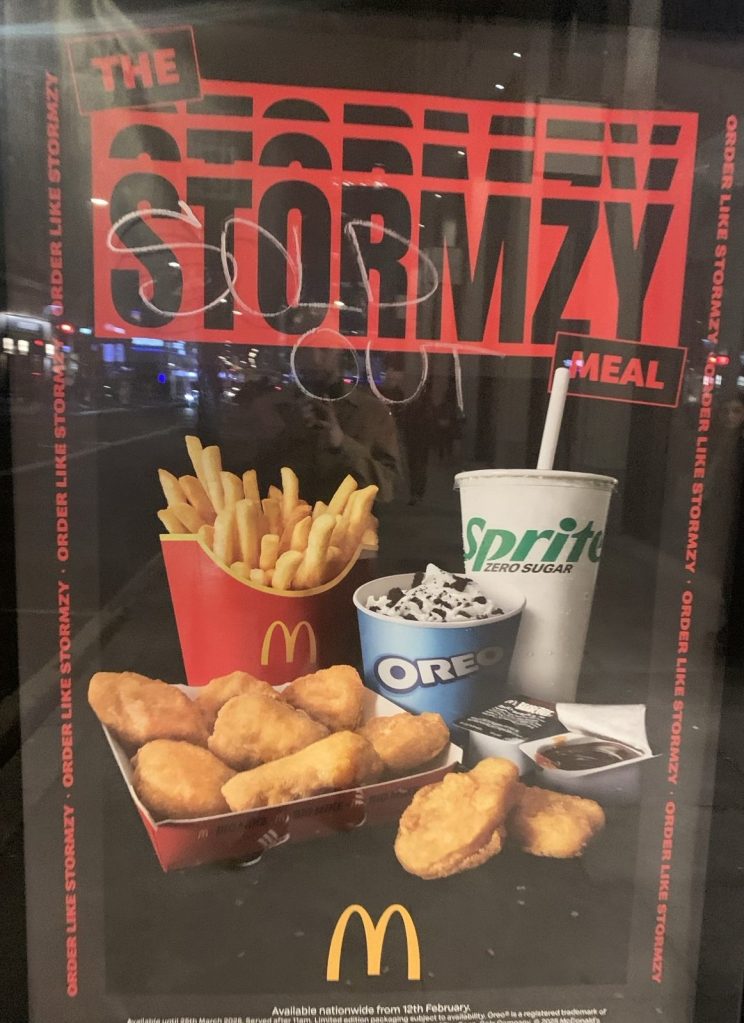
On to the second part of the sentence – “so now it’s just enjoy”. The “enjoy” could include reaping the rewards from all the work he’s done, such as by entering advertising partnerships with corporations like McDonalds. Many celebrities do this. Rita Ora’s face is everywhere, as is Charli XCX’s and David Beckham’s.
The difference with Stormzy is that he has largely made a name for himself by being “100 times out of 100 […] on the side of the oppressed” (his words). I don’t mind he’s working with McDonalds. But it’s clear that if you’re vocal about topics like justice and equality then it won’t be pretty when you sell your image to a company that many of your fans actively denounce.
I live in Kilburn, and around where I live and work most of the adverts have been vandalised. Comments on social media from accounts that seem to be his target demographic claim they always knew he was a sellout who would do anything for money and fame. It’s been relentless.
Back to Charlie Brinkhurst-Cuff’s 2023 article in The Guardian. It’s an illuminating portrait, one that shows an artist – then about to turn 30 – who is wealthy and successful, but also ill at ease with parts of his public image.
The overall tone of the piece is strange. Ostensibly, it’s a celebration of Stormzy and his good works, but underneath the compliments are these mentions of his ego and his appetite for amassing wealth and status objects. It’s worth remembering that The Guardian is a publication that has been very supportive of Stormzy throughout his career.
There’s a photoshoot of him with two recipients of his Cambridge University scholarships, as well as discussion of his role as a “political figurehead for progressives”. But the same article talks about his “throwing a literal gala for his 30th birthday”, and how he’s “spending £25,000 on a villa in Ibiza for a few days”.
Later in the interview, Stormzy says: “I feel, as a man of God, I hold myself to a higher standard.” A few paragraphs down, Brinkhurst-Cuff writes about him “getting ready to jet off in a banana-yellow Lamborghini”. She also notes that “discomfort is practically pouring out of him” when answering certain questions and that the “constant second-guessing of how his words are going to be perceived feels like it must be tiring”. He won’t be drawn into talking about the current state of politics (“I don’t know about none of these guys”), which is surprising, given his past.
The article spurred me to re-read another Guardian interview, this one with pop star George Ezra. The journalist, Laura Snapes, talks of Ezra’s progressive political upbringing, how “he recalls his parents, Labour party members, taking him on marches” and how his music celebrates “faith in collective goodness”. She mentions being “surprised to find he is crying” at one point in the interview when talking about the state of the world. It all contributes to the picture of Ezra as someone who cares deeply about humanity. But then she reveals that Ezra “is a surprisingly careful conversationalist, taking long pauses to risk-assess any admission”, which casts a slight shadow over the encounter and makes Ezra appear to be vaguely dissembling. There are moments where he deftly shuts down conversation avenues, one of which is when Snapes asks for examples of his past self-sabotaging behaviour. Tellingly, he talks about enjoying time he’s spent off-grid.

In both interviews, there are allusions to image control, the toll that fame takes on a person’s psyche, and the machine of celebrity in general. Perhaps I’m interested in both these figures because they’re roughly my age, and I remember the fanfare that surrounded them when they debuted a decade ago. Now in their thirties, in recent media they hint to past misdeeds without going into tangible and self-incriminating details. They seem jaded. There’s a sense that they want to be allowed to enjoy the fruits of their successes without criticism.
And this will repeat itself with a new generation of artists who will be, to varying degrees, broken by the same trappings of fame. In the case of Stormzy, I’m reminded of the Simpsons episode ‘Kamp Krusty’. Popular children’s entertainer Krusty the Clown lends his name to a holiday camp that is run like a gulag. When finally confronted about why he acted so irresponsibly, Krusty cries:
“They drove a dump truck full of money up to my house. I’m not made of stone.”
And the lines are delivered like he’s the victim, rather than the children who attended the holiday camp. It’s as though celebrities – perhaps due to their natures, which drive them to seek fame in the first place – are powerless to resist these invitations for further financial gain or exposure.
And for that they deserve our sympathy.
 Harry Dobbs
Leave a comment